Case study · Consulting
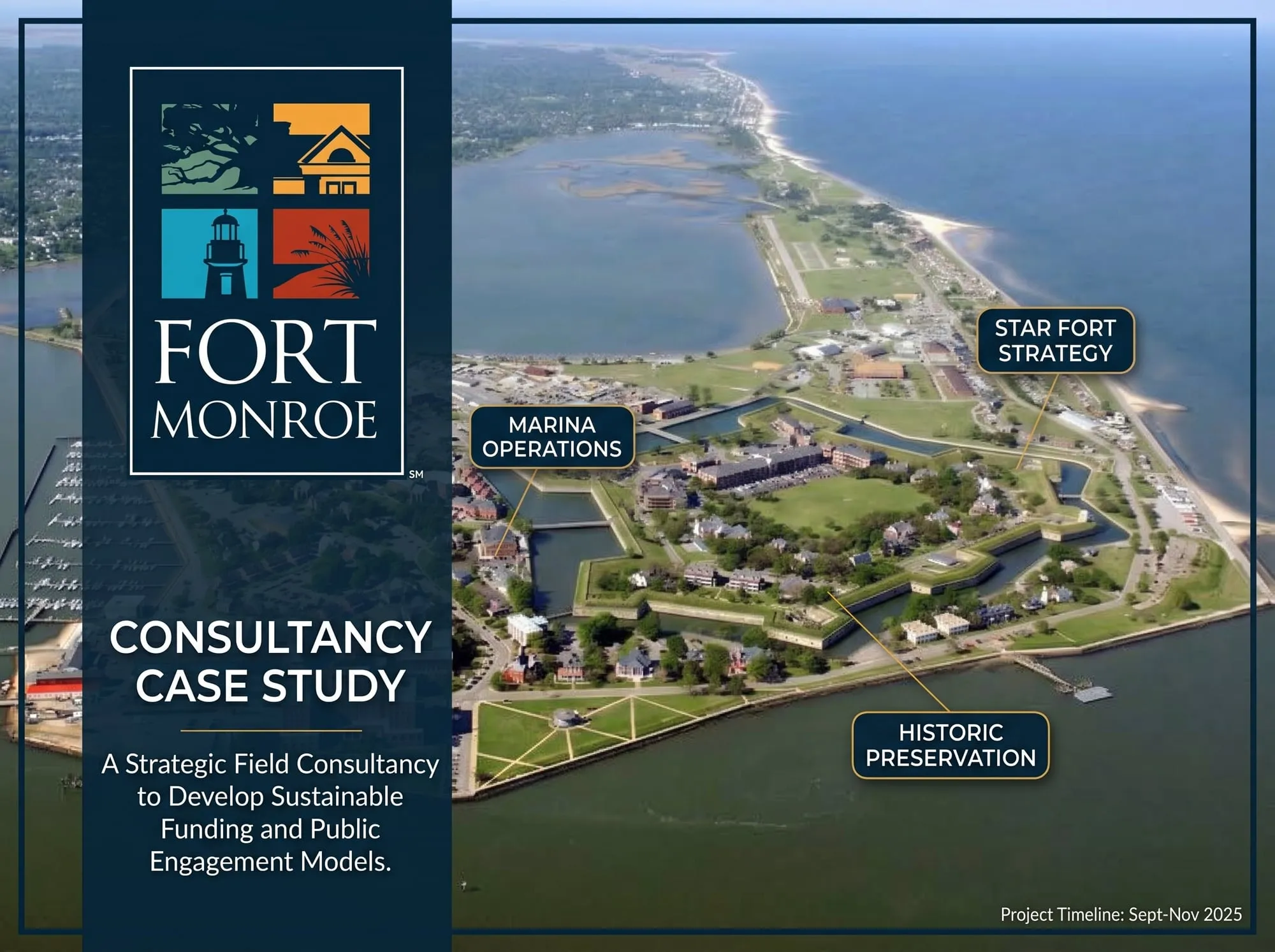
Fort Monroe Consultancy
Seven weeks, four deliverables, one of five consultants, for a historic site required to pay its own way.
- 226
- 4
- 7 wks
- 1 of 5
- Situation
- Fort Monroe is a National Historic Landmark on the Virginia coast, run by a state-created authority under a mandate to largely pay for itself. It carries 560-plus acres and around 1.5 million square feet of vacant historic buildings, and it was planning events and considering monetizing parking without a current picture of how the public actually saw the place.
- Task
- An MBA corporate field consultancy — five consultants, seven weeks, September to November 2025. I was the primary interface with the client's leadership team and owned four of the engagement's deliverables.
- Action
- Four deliverables: a 226-respondent perception survey designed and analysed end to end; a parking monetization make-or-buy analysis recommending a revenue-share hybrid over five benchmarked alternatives; a 15th-anniversary event plan costed for full recovery at free admission; and a Central Park Conservancy comparative on what actually transfers to a self-funded historic site.
- Result
- The client rated the engagement highly in an independent post-project review and commissioned a follow-on engagement for the following year — the strongest quality signal available for this kind of work.
The credibility angle leads, because it’s worth more than any single deliverable: two of the four findings below cut against what the team wanted to hear, and both were reported anyway.
The four deliverables
A 226-respondent perception survey, designed and analysed end to end, branched by familiarity so residents, frequent visitors and first-time visitors each answered a coherent set of questions rather than one compromise questionnaire.
A parking monetization make-or-buy analysis benchmarked against five comparable sites, recommending a hybrid: contract an operator initially on revenue share rather than a flat fee so incentives align, keep rate and policy control, and plan for possible in-housing later.
A 15th-anniversary event plan for November 2026, with a revenue stack — sponsorship, tourism funds, on-site donations, ticketed premium experiences, vendor fees — engineered for full cost recovery at free general admission.
A Central Park Conservancy comparative tracing which parts of CPC’s model actually transfer to a site managing built historic assets under a self-sustainability mandate, rather than a designed landscape under philanthropic stewardship — and which don’t.
What the survey found
Consistent across every segment, the survey put food, events and ease of navigation as the strongest levers for visitation and satisfaction — all three actionable without capital construction, which matters for an organization with no capital to spend.
The survey also ranked improved parking last as a visitation driver. That was inconvenient for the team’s own parking workstream. It was reported anyway.
The catch
A second finding was a catch, not a result: a benchmark figure from another site had migrated into the team’s roadmap as if it were a Fort Monroe baseline, at roughly double the real local figure. Publishing a recommendation on top of it would have been a real error — caught by tracing the number back to where it actually came from, before it went out the door.
The response
Post-project client interviews are conducted independently for every engagement in this program. The client reported being most pleased with this one and commissioned a follow-on engagement for the following year.